

Why Most Businesses Fail at Social Media Marketing (And What Actually Works in 2026)
You’re Showing Up. But You’re Not Being Seen.
You’ve been consistent.
You’ve posted the reels.
You’ve approved the designs.
You’ve tried the trends.
And still—
- Engagement spikes randomly, then drops
- Followers increase, but inquiries don’t
- People watch your content… but don’t remember your brand
And slowly, a quiet frustration builds:
“We’re doing everything right… so why isn’t it working?”
Here’s the truth most agencies don’t say out loud—
Social media marketing doesn’t fail because you’re not doing enough.
It fails because what you’re doing doesn’t mean anything.
The Shift No One Talks About
There was a time when:
- Posting regularly worked
- Following trends gave visibility
- Basic content got engagement
That time is over.
In 2026, social media is no longer a platform advantage.
It’s a perception game.
People don’t engage with content just because it exists.
They engage when something:
- feels real
- feels different
- feels worth their attention
And that’s exactly where most brands lose.
The Real Problem: Activity Without Identity
Most businesses today are active on social media.
But very few are clear.
Their content:
- changes tone every week
- follows every trend
- speaks to everyone (and connects with no one)
So even if people see your brand multiple times—
- they don’t recognise you
- they don’t associate anything with you
- they don’t remember you
And if you’re not remembered—
you’re not chosen.
5 Reasons Why Social Media Marketing Fails
Let’s break this down clearly.
1. There Is No Core Narrative
Most brands don’t have a story.
They have: offers, services and products
But no central idea that ties everything together.
So content becomes: disconnected, repetitive and forgettable
A strong brand answers one simple question:
“What do we stand for?”
Without that, content is just noise in a crowded feed.
2. Content Is Created for the Algorithm, Not the Audience
This is one of the biggest traps.
Brands ask: “What’s trending?” and “Which audio is viral?”
Instead of asking: “What would my audience actually relate to?”
The result?
Content that:
- may get views
- but doesn’t build connection
- and definitely doesn’t build loyalty
Because virality without relevance is empty.
3. Everything Looks the Same
Scroll for 10 minutes and you’ll see it—
- identical transitions
- similar scripts
- same hook lines
- same editing styles
Different brands. Same content.
And when everything looks the same—
- nothing stands out
- nothing sticks
- nothing converts
Your audience doesn’t need more content.
They need a reason to notice you
4. There Is No Emotional Layer
Most brands communicate what they do.
Very few communicate how it feels to experience them.
And that’s a big gap.
Because people don’t choose based on logic alone.
They choose based on: emotion, relatability and connection
A café isn’t just: “Serving coffee”
It’s: quiet mornings, long conversations and late-night laughter
If your content doesn’t reflect that—
you’re not selling the experience, you’re just listing features.
5. There Is No System Behind the Content
What most brands call “strategy” is actually just scheduling.
But real strategy includes:
- content direction
- audience mapping
- format selection
- platform behaviour
- performance analysis
Without a system, content becomes reactive.
And reactive content rarely builds long-term growth.
So, What Actually Works in 2026?
Now let’s shift to what does work—because this is where most blogs stay shallow.

1. Build a Strong Brand Narrative
Before content, define your story.
Ask:
- What should people associate with us instantly?
- What emotion do we want to trigger?
- What makes us different from others in our category?
Your content should feel like chapters of the same book.
Not random pages.
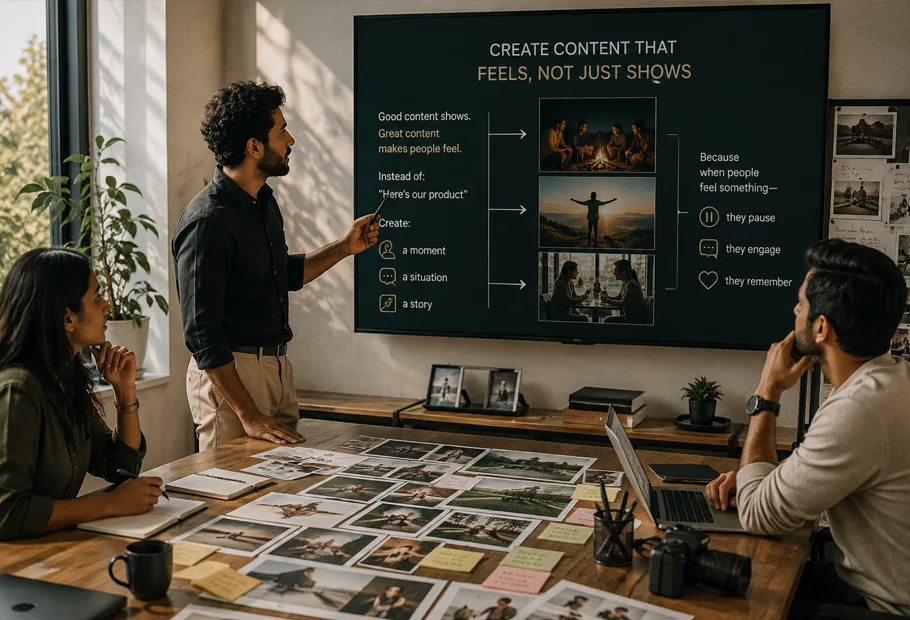
2. Create Content That Feels, Not Just Shows
Good content shows.
Great content makes people feel.
Instead of:
“Here’s our product”
Create:
a moment
a situation
a story
Because when people feel something—
- they pause
- they engage
- they remember

3. Design for Attention, Not Just Aesthetics
Aesthetic content is everywhere now.
But attention-grabbing content requires:
- strong hooks
- visual movement
- relatable situations
- unexpected storytelling
In simple terms:
If your first 3 seconds don’t stop someone—nothing else matters.
4. Focus on Fewer, Better Pieces of Content
Instead of chasing quantity—
invest in:
- stronger ideas
- better execution
- deeper storytelling
One impactful reel can:
- bring visibility
- spark conversations
- drive footfall
While 10 average posts do nothing.
5. Build Interaction, Not Just Visibility
Posting is passive.
Engagement is active.
Growth happens when you:
- reply meaningfully
- initiate conversations
- acknowledge your audience
Because people don’t just follow brands.
They connect with brands that feel human.
6. Use Ads to Amplify, Not Replace Content
Ads don’t fix bad content.
They amplify good content.
The right approach is:
- create strong organic content
- identify what works
- scale it through ads
That’s how visibility turns into conversion.
What This Looks Like in Reality
A brand that gets social media right:
- feels consistent
- feels recognisable
- feels relatable
Over time:
- People start remembering it
- People start recommending it
- People start choosing it
And that’s when social media actually starts working.
Why Most Agencies Still Get This Wrong
Because it’s easier to sell:
- number of posts
- number of reels
- number of deliverables
Than to sell:
- thinking
- strategy
- storytelling
But numbers are easy to deliver.
Impact is not.
A Different Way to Approach Social Media
At Storify Solutions, the focus is not on filling your content calendar.
It’s on building something people remember.
What That Means Practically:
- Understanding your brand deeply before creating anything
- Designing a content direction, not just content pieces
- Creating narratives that evolve over time
- Adapting strategy based on response—not sticking to rigid plans
Because growth doesn’t come from doing more.
It comes from doing what actually matters.
Final Thought
If your social media feels like:
- effort without clarity
- consistency without growth
- visibility without results
Then the problem isn’t the platform.
It’s the approach.
Because in 2026—
The brands that win aren’t the ones that post the most.
They’re the ones people remember without trying.
If you want your social media to move beyond activity—and start creating real impact—
Reach out to Storify Solutions
Frequently Asked Questions
Why is my social media marketing not working?
Social media marketing often fails due to a lack of clear strategy, weak storytelling, and inconsistent brand identity. Many businesses focus on posting regularly without defining their audience, positioning, or content direction, which leads to low engagement and poor conversions.
Is posting daily necessary for social media growth?
Should I focus more on reels or static content?